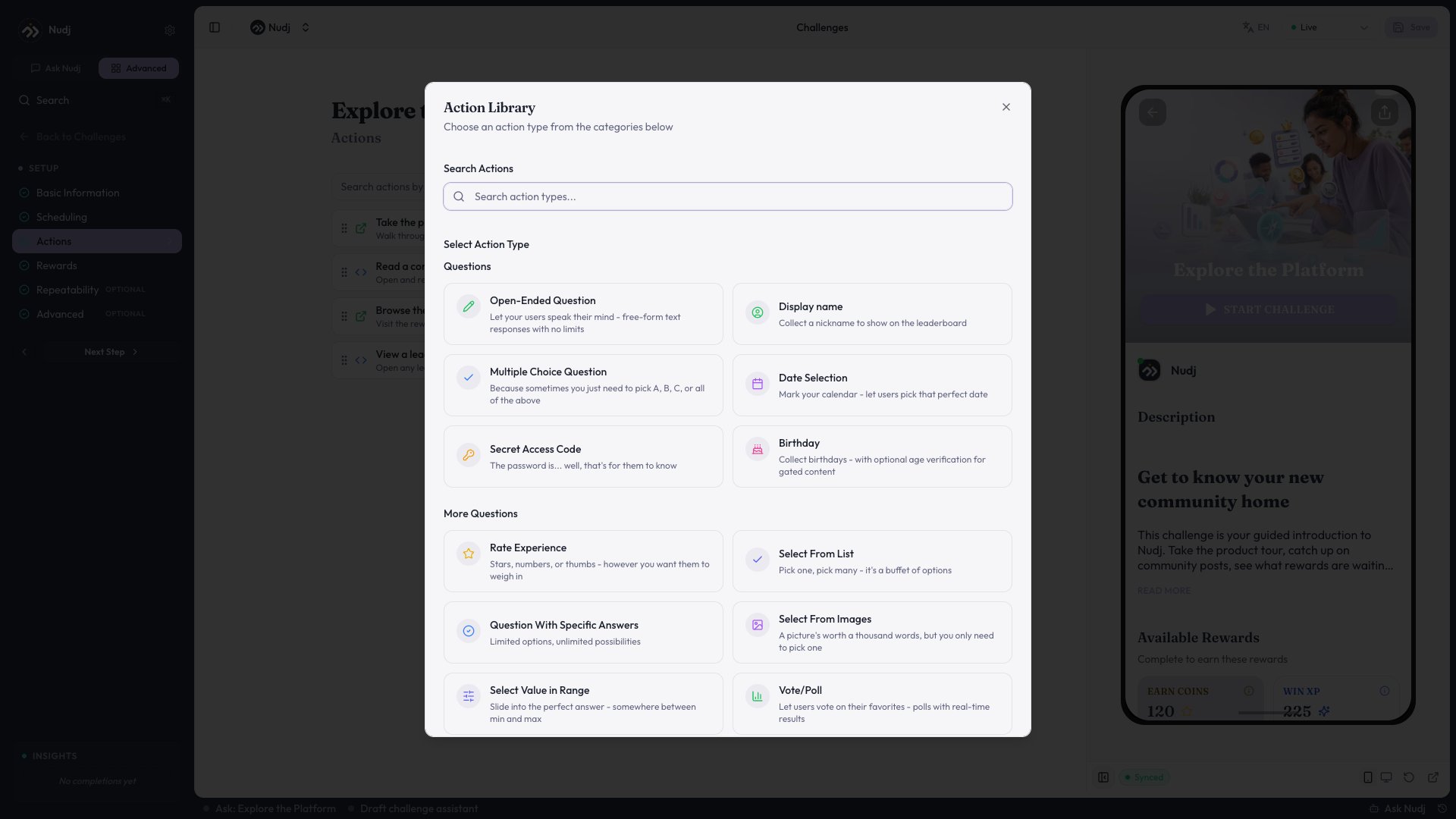

Rich media actions go beyond text and questions. Videos, images, interactive content, file uploads—these are how you create experiences instead of just tasks. The principle is simple: show something, have users interact with it or upload their own, track that it happened.

Rich Media Action Types

Rich Content

HTML content with embedded media and interactive elements

External Link

Visit external websites as part of challenge completion

Image Upload

Upload images with validation and processing capabilities

Rich Content Actions

Rich content is video, images, interactive elements—anything beyond plain text. Think of this as your opportunity to show users something, not just tell them. A training challenge with an embedded video will always outperform the same content as a text description. Users engage more deeply with visual and interactive content. This is where you:
  • Embed media directly: Videos play right in the challenge, no context switching
  • Add interactive elements: Hotspots, hover effects, dynamic reveals that give users something to do beyond just reading
  • Brand the experience: Custom CSS lets you style content to match your community’s look
  • Optimize for all devices: Responsive design ensures it works on mobile, tablet, desktop
Content Types
  • Educational Content
  • Marketing Content
  • Community Content
  • Assessment Content
Interactive learning materials: embedded videos with synchronized transcripts, interactive diagrams and infographics, step-by-step tutorials with visual elements, progressive disclosure of information.
Security and Validation
  • Content Sanitization: Remove potentially harmful scripts and elements
  • Media Validation: Verify uploaded media meets format and size requirements
  • Performance Optimization: Compress and optimize media for fast loading
  • Accessibility Compliance: Ensure content meets accessibility standards

External link actions send users outside your platform to read an article, use a tool, or access a resource. This is useful when the content already exists elsewhere and sending users to it is faster than recreating it. The risk: users click the link and never come back. So be intentional about it. Use external links when:
  • The resource is genuinely valuable and not available internally
  • You want to drive traffic to a specific source (like a partner site or your company blog)
  • The context changes often (like an external tutorial that updates frequently)
Don’t use external links just to avoid hosting content yourself. If it’s critical to your challenge, host it locally.

Educational Resources

Articles, tutorials, courses, or knowledge bases that teach a concept

Tools & Applications

Software, converters, calculators, or interactive tools users need to use

Community Resources

Forums, Discord communities, Reddit threads, or peer support networks

Content Collections

Databases, libraries, or repositories where users explore options
When you point people outside your platform, think about:

Image Upload Actions

Image uploads let users contribute visual content to challenges. Perfect for creative submissions, verification, and user-generated content. Upload Features
  • File Requirements
  • Content Guidelines
  • Maximum file size limits (e.g., 10MB per image)
  • Supported image formats (JPG, PNG, WebP, etc.)
  • Minimum resolution requirements (minimum 800x600px)
  • Aspect ratio constraints (if applicable)
Image Processing Pipeline
1

Upload Validation

Verify file format, size, and basic image integrity
2

Content Scanning

Automated checks for inappropriate or harmful content
3

Image Optimization

Resize, compress, and optimize images for platform use
4

Metadata Generation

Extract and store relevant image information and properties
5

Quality Review

Optional manual review for content quality and appropriateness
Image Use Cases
  • Portfolio Submissions
  • Documentation
  • Community Sharing
Design challenges: submit creative work for evaluation, photography contests for original photography, art projects for creative expressions, skill demonstrations for visual proof of completed work.

Best Practices

Performance Optimization
  • Loading Performance
  • User Experience
  • Image compression and optimization - Reduce file sizes without quality loss
  • Progressive loading - Load large media files progressively to users
  • CDN integration - Global performance and fast delivery
  • Responsive media serving - Serve optimized sizes for different devices
Content Quality Management
  • Automated Screening: AI-powered content analysis and filtering
  • Community Moderation: Peer review and reporting systems
  • Admin Review: Manual approval processes for sensitive content
  • Quality Metrics: Tracking and improvement of content standards
Accessibility
  • Alt Text Requirements: Mandatory descriptions for uploaded images
  • Keyboard Navigation: Full keyboard accessibility for all media actions
  • Screen Reader Support: Proper markup and announcements
  • Visual Accommodations: High contrast modes and text scaling options
Rich media actions are most effective when they directly support your challenge learning objectives. Don’t add multimedia just for visual appeal—ensure every rich media element serves a specific purpose in the user experience.
Always consider bandwidth limitations and device capabilities when implementing rich media actions. Provide fallback options for users with slower connections or older devices.

Rich media actions transform static challenges into dynamic, engaging experiences that can accommodate diverse learning styles and create memorable user interactions.